Asian Shares Post Mostly Higher Trading Ahead of Wall Street Reopening
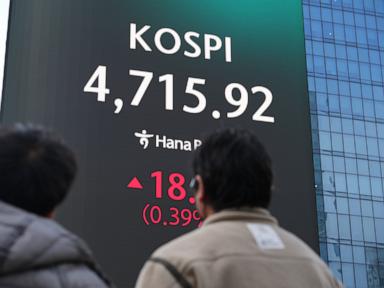
Asian Markets Trend Upward Following U.S. Thanksgiving Holiday
According to reporting by Yuri Kageyama of the Associated Press, Asian shares were mostly trading higher during early Friday sessions. The movement followed a market closure on Wall Street for the Thanksgiving holiday, with regional investors tracking both technological sector trends and upcoming macroeconomic policies.
U.S. markets were scheduled to reopen later on Friday for a holiday-shortened trading session, bringing renewed focus from international traders onto American economic indicators and market activity.
Regional Benchmark Performance
Stock indexes across the Asia-Pacific region experienced varied yet predominantly positive movements during morning trading hours:
- Japan: The benchmark Nikkei 225 added 0.7% to reach 57,919.30.
- South Korea: The Kospi surged significantly, posting a 2.2% gain to hit 4,812.65.
- Australia: The S&P/ASX 200 rose by 0.4% to 8,800.50.
- Hong Kong: The Hang Seng edged upward by 0.4% to stand at 22,310.11.
- China: Bucking the broader regional trend, the Shanghai Composite slipped slightly by 0.1% to 3,473.40.
The Role of Artificial Intelligence and Tech Stocks
According to the source reporting, ongoing purchasing activity surrounding equities tied to artificial intelligence has played a major role in driving benchmarks higher. This upward momentum has persisted despite occasional bouts of profit-taking that have kept overall gains in check.
As an illustration of this resilience, Japanese chip-related equities such as Tokyo Electron and Advantest Corp. initially encountered downward pressure during morning trading. However, these issues quickly recovered their losses, highlighting the enduring investor demand for computer chip and artificial intelligence assets.
Global Concerns and Tariff Watch
Beyond regional tech stock momentum, investors across Asia are reportedly maintaining close observation of potential economic fallout. Market participants are watching for possible damage to the region stemming from planned U.S. tariff hikes directed at China, Japan, the European Union, and other key trading partners.
The source noted that China and other U.S. trading partners have previously hit back at these new tariff plans, creating an environment of policy uncertainty for international trade.
Energy Markets and Currency Fluctuations
Energy trading remained subject to recent volatility, driven largely by uncertainty surrounding ongoing tensions in the Middle East:
- Benchmark U.S. crude increased by 2.09%, trading at $85.43 per barrel.
- Brent crude, serving as the international standard, slipped by 0.29% to $96.29 per barrel.
In foreign exchange markets, the U.S. dollar experienced minor movements. The greenback inched upward against the Japanese yen, moving to 159.25 Japanese yen compared to the previous 159.23 yen. Meanwhile, the euro experienced a slight decline, trading at $1.0967 down from $1.0975.
Additional Context and Reporting
Additional reporting contributions for the coverage were provided by AP Business Writer Chan Ho-Him. The original information and ongoing updates regarding these financial developments can be accessed directly through the Associated Press report on ABC News.
Post a Comment