Putin can no longer say that he won in Ukraine
Award winner for peace, Putin can no longer say that he won in Ukraine.
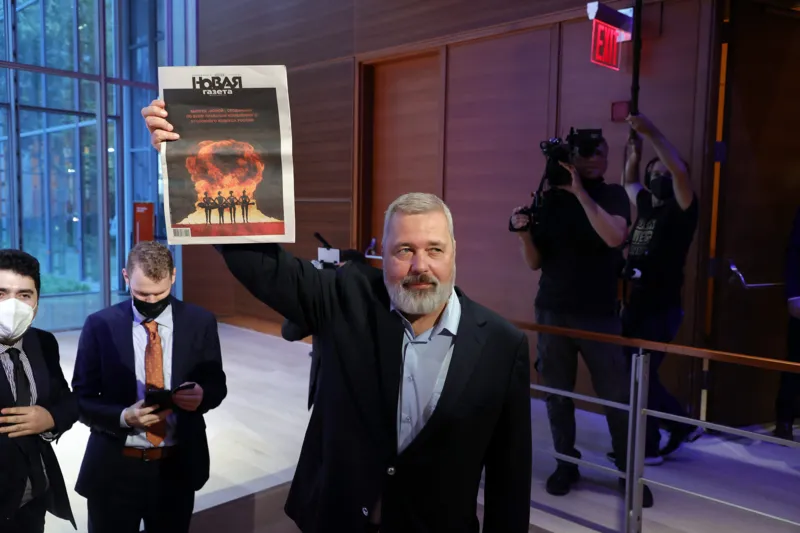
"There is no newspaper anymore," former chief editor Dmitry Muratov tells me, describing the terrible feeling of desolation.
Over thirty years ago, Mr. Muratov was a co-founder of Novaya Gazeta. It rose to prominence as Russia's leading independent news outlet, exposing high-level corruption and violations of human rights.
Mr. Muratov shared the 2021 Nobel Peace Prize in recognition of his work "to safeguard freedom of expression." The Nobel Committee reported that "six of [Novaya Gazeta's] journalists have been killed, including Anna Politkovskaya who wrote revealing articles on the war in Chechnya."
It was an award for brave reporting. However, the journal was not protected. According to Mr. Muratov, "Putin issued a decree and the newspaper's printing presses were nationalized." "Its registration was revoked."
Novaya Gazeta is still active on the internet. However, access to its website has been banned by the authorities. Only from overseas or with the aid of virtual private networks, or VPNs, which are used to get around limitations, can it be viewed.
The newspaper's problems are a reflection of Russia's wider suppression of free speech, which has intensified since the Kremlin's full-scale invasion of Ukraine in 2022.
The majority of opinion leaders have been labeled as "terrorists," "foreign agents," or "extremists." "A few hundred," Dmitry Muratov replies.
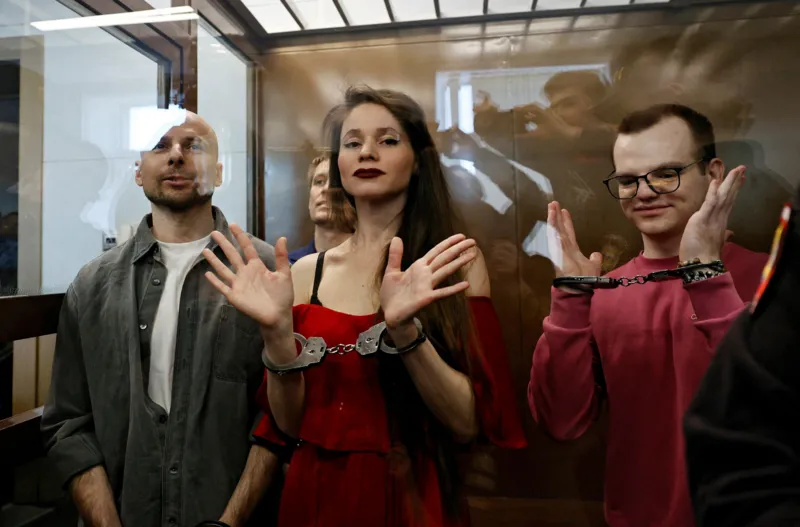
Journalists Antonina Favorskaya, Konstantin Gabov, Sergey Karelin and Artyom Kriger were jailed on extremism charges for five and half years
Since the beginning of Russia's 'special military operation' [in Ukraine], at least 1,500 people have been imprisoned for speaking out against present official policy, according to a conservative estimate. That is three times greater than it was in the USSR during the brutal KGB era.
Dissident Andrei Sakharov enumerated the names of over 120 political prisoners he knew of in the Soviet Union in his 1975 Nobel Peace Prize lecture. Ten years later, Amnesty International estimated that there were over 600 prisoners of conscience in the USSR.
Post a Comment